Why you still need to ask
"Accessible" is not one fixed standard. A property might mean a ground-floor room, a room with a few adaptations, or a fully wheelchair-accessible wet room, and a listing badge does not tell you which. VisitEngland's National Accessible Scheme, which used to rate accommodation on a common standard, closed to new participants and stopped operating from 31 July 2025. Its replacement is detailed, venue-specific accessibility information rather than a single award, so checking the specifics yourself matters more than it used to.
Use the points below as a list of questions for the property, not assumptions from the word "accessible" alone. That applies whether you found the property on our accessible hotels list or anywhere else.
Getting to the room
Step-free access and lifts
- Is there step-free access from the car park or street to reception, and from reception to the room?
- If there are stairs, is there a lift, and what are its internal dimensions?
- Are there any single steps or thresholds that would not show up as "stairs" but still stop a wheelchair, such as a raised doorway or a step down into a bathroom?
Door and corridor widths
- What is the clear width of the room door and the bathroom door?
- Is there enough turning space inside the room for a wheelchair?
- Are corridors wide enough for two people to pass, if that matters for you or a carer?
The bathroom
Bathroom type is one of the most commonly misunderstood parts of an accessible booking. A "walk-in shower" is not always a level-access shower, and a bath with a rail is not the same as a wet room. The words on a listing describe the fixture, not the clearance around it, so ask about both.
- Is the shower level access (no step or lip), or is there a raised tray?
- Are there grab rails, and where are they positioned relative to the toilet and shower?
- Is there a shower seat, and is it fixed or portable?
- Is the toilet at a standard or raised height, and is there space to transfer from a wheelchair on both sides or only one?
- Is there an emergency pull cord in the bathroom, and where does it alert staff?
The bed and the room
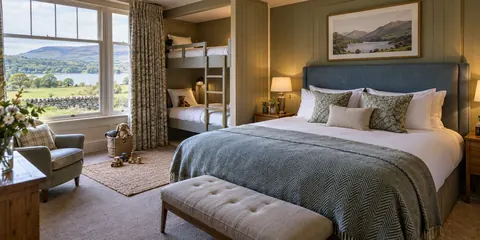
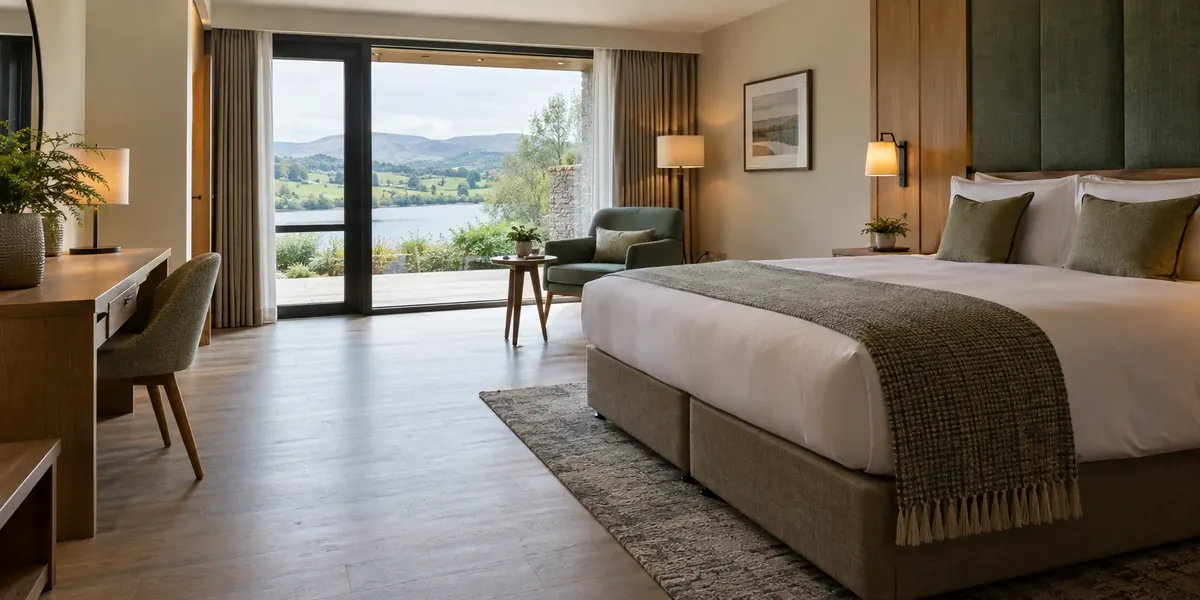
A room described as "accessible" on a listing can still have a bed that is too high, too low, or too close to a wall to transfer safely. These details rarely make it into a general description, so treat the bed itself as its own checklist item rather than assuming it is covered by the word "adapted".
- What is the bed height, and can it be adjusted or swapped for a higher or lower one?
- Is there clear space beside the bed for a wheelchair or hoist?
- Does the property have a hoist, or can you bring a portable one, and is there a suitable fixing point?
- Is there a plug socket at a height you can reach from a bed or chair, for charging equipment overnight?
- Is the room on a quiet side of the building, if noise sensitivity matters to you?
Travelling with a companion or carer
If you are travelling with a carer or a companion who needs their own bed, say so when you enquire rather than after booking a standard twin or double. Ask whether an adjoining or interconnecting room is available, and whether a second bed can be added to an accessible room without reducing the turning space you need.
- Is there a sofa bed or a separate single bed option within an accessible room?
- Can the property confirm the layout in writing before you pay a deposit?
- If your companion also has access needs, does the property have more than one accessible room available on the same night?
Hearing, sight and communication
- Is there a hearing loop at reception or in public areas?
- Are fire alarms visual as well as audible in the room?
- Can staff communicate in writing or by text if a phone call is not practical?
Assistance dogs
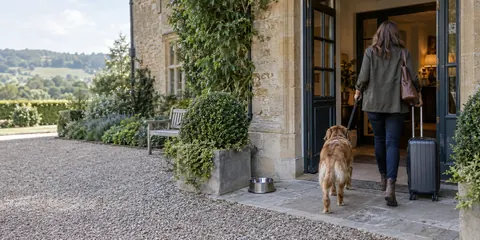
Under the Equality Act 2010, service providers such as hotels must not refuse a disabled guest access because they are accompanied by an assistance dog, and cannot charge an extra fee for the dog. Guidance for businesses from the Equality and Human Rights Commission, the body that enforces the Act, is clear that a blanket "no dogs" policy cannot be applied to a trained assistance dog. Exceptions are rare and must be justified on health and safety grounds specific to that guest, not a general house rule.
This covers guide dogs, hearing dogs and other trained assistance dogs supporting a range of conditions, not only visual impairment. It applies across the stay, from the room to shared spaces such as a dining room or lounge.
- You do not need to show certification, though many owners carry ID for convenience
- Ask the property where the dog can go with you, including restaurants and lounges, and where it will sleep
- Ask whether other guests with allergies are managed in a way that would affect where you and the dog can sit
- If a property refuses an assistance dog outright, that is worth raising directly with them, since it is unlikely to be lawful under the Equality Act 2010
Parking and arrival
Getting from the car, taxi or station to the room is its own leg of the journey, and it is easy for a property to describe the room in detail while leaving the route to it vague. Ask about the whole path, not just the destination.
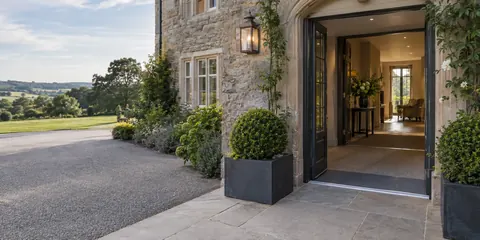
- Is there a designated accessible parking space, and how close is it to the entrance?
- Is the route from that space to the door step-free and covered, or exposed to weather?
- If you are arriving by train or coach, how far is the nearest step-free station, and is there an accessible taxi service locally?
- Can you arrange an earlier or later check-in if you need more time to settle in?
How accessibility statements work
Many properties now publish a detailed accessibility guide rather than a simple badge, in the format VisitEngland promotes through its partnership with AccessAble: room-by-room measurements, photographs and specific facilities, rather than a general rating. Where a property has one, read it in full before booking, since it usually answers most of the questions above in one place.
Where there is no detailed statement, put the same questions to the property directly by phone or email, and ask them to confirm in writing. A written description can miss a detail that a photograph settles in seconds, so ask for photos of the room, the bathroom and the route from the entrance, and for a simple floor plan with dimensions if one exists.
A booking made on an assumption is harder to resolve on arrival than a question asked in advance. If something turns out to be different from what was confirmed, raise it with the property as soon as you notice, while there is still time to fix it or move you to a suitable room.