What a hotel actually means by EV charging
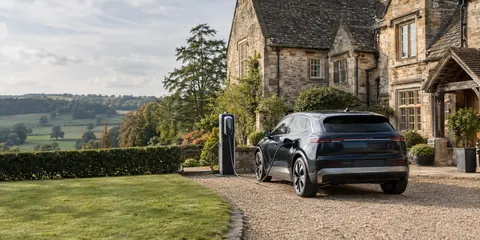
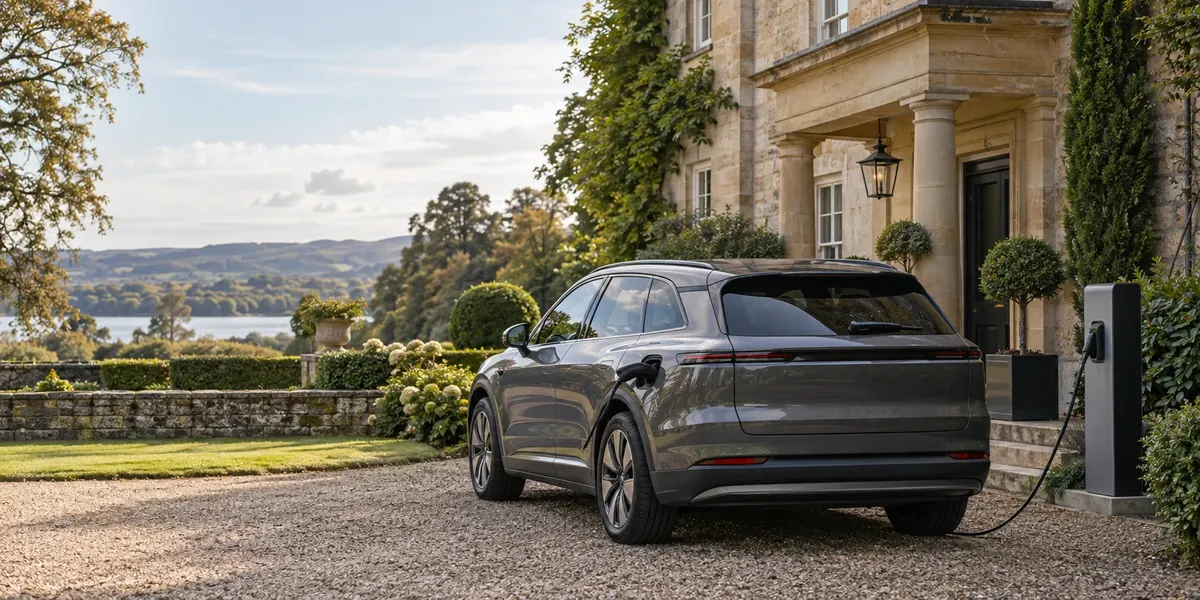
A hotel or lodge listed as having EV charging might have anything from a single untethered socket in a corner of the car park to several fast chargers with their own app. The listing rarely says which, so it is worth treating "EV charging is listed" as a starting point for a question, not an answer.
Two things decide whether a charger is useful for your stay: the connector type, which determines whether your cable will fit, and the power rating in kW, which determines how much charge you get overnight.
Connector types: Type 2, CCS, tethered and untethered
Almost all public and commercial AC chargepoints in the UK use a Type 2 socket, built to the BS EN 62196 standard. GOV.UK's technical specification for commercial chargepoints sets out Type 2 as the required connector for semi-rapid and rapid AC equipment. It also recommends Type 2 for standard and fast AC units, so it is the connector you should expect at a hotel.
Tethered or untethered
- Tethered: the charger has its own cable permanently attached. You plug the far end straight into your car.
- Untethered: the charger has a socket only. You need your own Type 2 to Type 2 cable, usually kept in the boot.
CCS and rapid charging
CCS (Combined Charging System) adds two extra DC pins to a Type 2 connector and is used for rapid and ultra-rapid DC charging, mostly at motorway services and dedicated charging hubs rather than at hotels. GOV.UK's specification defines rapid DC as above 50kW. Most hotel car park chargers are AC, not CCS.
Power ratings and what they mean overnight
GOV.UK's minimum technical specification for commercial chargepoints groups AC power into bands: standard AC from above 3.5kW to 7kW, fast AC from above 7kW to 23kW, and semi-rapid AC from above 23kW to 43kW. A typical hotel car park charger sits in the 7kW to 22kW range.
- A 7kW charger adds roughly 25 to 30 miles of range per hour, so an 8 to 10 hour overnight stay can comfortably add well over 100 miles for most family-sized EVs.
- A 22kW charger works faster in principle, but many cars only accept up to 7kW or 11kW on a single-phase AC connection, so the car's onboard charger, not the wallbox, can be the limit.
- Rapid and ultra-rapid DC chargers (43kW and above) are rare at hotels. If you need a fast top-up on the way, plan for a public rapid charger rather than relying on the hotel.
None of this tells you what you will actually get, because a shared charger can be in use by another guest when you arrive. That is the practical case for booking ahead where the hotel allows it.
Do you need to book the charger
Some hotels allocate car park chargers on a first come, first served basis. Others ask you to reserve one at booking or on arrival, especially where there are only one or two points for the whole car park. Ask when you book, not when you arrive with 20% charge left.
Costs: free, included or pay per kWh
Charging at a hotel falls into roughly three patterns: free for guests, included in the room rate, or billed separately at a pence-per-kWh rate through the charger's own app or card reader. None of these is more common than the others across the whole market, so it is worth asking rather than assuming.
Where a hotel's charger falls under the Public Charge Point Regulations 2023, the operator must display the price in pence per kilowatt hour, on the charger or through a linked app. That price cannot increase once your charge has started. New public chargepoints of 8kW and above, and existing chargepoints of 50kW and above, must also offer contactless card payment. A private, guest-only wallbox in a hotel car park may not count as a "public" charge point under the regulations. That is another reason to ask the hotel directly how it bills for charging.
Apps, RFID cards and payment
Some hotels use a third-party network, such as Pod Point, Osprey or BP Pulse. If yours does, you may need that operator's app or an RFID card to start a session, even if the electricity itself is free for guests. Download the relevant app before you travel if the hotel tells you which network it uses. Hotel wifi at check-in is not the moment to discover you need a new account.
Charge point operators covered by the Public Charge Point Regulations 2023 must also run a staffed telephone helpline, free to call, available 24 hours a day, with the number displayed on or near the charger. If a charger will not start a session, that number is worth trying before you give up.
Planning ahead, and what to do if a charger fails
A hotel charger is usually there to top you up overnight, not to take you from empty to full on a motorway timetable. If your route needs a rapid or ultra-rapid DC charge to arrive with enough range, plan that stop on the way. Use a motorway service area or a dedicated charging hub, rather than counting on the hotel's slower AC point to do the job in an hour.
- Check your own car's maximum AC charging rate before you travel. Some models cap at 7kW or 11kW even on a 22kW charger.
- Cold weather reduces range and slows charging speed, so build in a margin on winter trips.
- If you are relying on the hotel charger to get home, ask what time you can access it and whether other guests are also charging that night.
- If a listing does not mention EV charging at all, that does not always mean there is none. Facilities can change between updates, so ask the property directly.
A charger that will not start a session is a common frustration rather than a rare fault. Try the operator's app first, since a poor signal in a car park can stop a session starting even when the hardware is fine. If the chargepoint is covered by the Public Charge Point Regulations 2023, the 24 hour helpline number should be displayed on or near the unit. Call it before assuming the charger is broken.
If the charger is genuinely out of order, ask reception whether there is a second point, how long a repair typically takes, and whether the nearest public charger is within walking distance. None of this is guaranteed by the property, but it costs nothing to ask, and it is easier to plan around a known gap than an unexpected one.
Questions to ask the property
- How many charging points are there, and are they shared with the public or guests only?
- What connector do they use, and is the cable tethered or do I need my own?
- What is the power rating in kW?
- Is charging free, included in the room rate, or charged separately, and how do I pay?
- Do I need to book a charger in advance, and is there a time limit once my car is full?
- Which network or app runs the charger, if any?